Non-Surgical Hair Regrowth: Ranking the Monotherapies
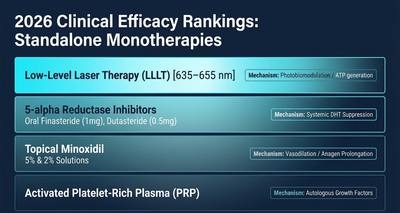
Across the 40+ randomized controlled trials, meta-analyses and 2026 dermatological guidelines behind the 2026 Clinical Efficacy Scale, non-surgical regrowth resolves into four mechanism families - and they do not rank equally. Low-level laser therapy at 635-655 nm drives photobiomodulation and ATP generation; 5-alpha reductase inhibitors suppress systemic DHT; topical minoxidil prolongs the anagen phase through vasodilation; activated platelet-rich plasma delivers autologous growth factors. The data-backed verdict is blunt: no standalone agent beats a multi-pathway protocol on density or shaft thickness, so the ranking is a sequencing tool, not a shopping list.
How the 2026 Scale Was Built
The scale compresses 40+ randomized controlled trials, pooled meta-analyses and 2026 dermatological guidelines into a single matrix. Each agent is scored on primary mechanism, efficacy ceiling (density), ideal candidate and systemic side-effect risk, because a therapy that adds density through one pathway cannot be compared directly to one that halts follicular miniaturization through another. The efficacy scale walkthrough lays out that hierarchy end to end.
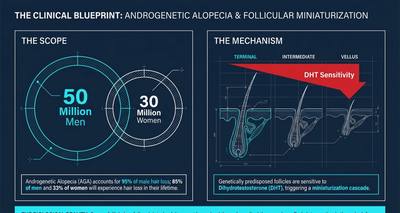
Terminology has to come before numbers. Androgenetic alopecia accounts for 95% of male hair loss, and the follicles it touches move through three documented states: terminal, intermediate and vellus. A drug that prolongs anagen behaves very differently on a terminal follicle than on one already reduced to vellus, which is why a single "effectiveness" percentage for the whole category is meaningless.
| Monotherapy | Primary mechanism | Form / delivery | Efficacy ceiling (density) | Best-fit candidate |
|---|---|---|---|---|
| LLLT (650 nm) | Photobiomodulation / ATP generation (Complex IV) | Light at 635-655 nm | High (+25.7 hairs/cm2) | Non-responders to chemicals; adjunct therapy |
| Oral finasteride | Systemic DHT suppression | Oral, 1 mg | High | Male AGA, early-to-mid stage |
| Topical minoxidil | Vasodilation / anagen prolongation | Topical, 5% and 2% solutions | Moderate-High | Universal baseline therapy |
| Activated PRP | Autologous growth factor delivery | Injected; thrombin / calcium chloride activation | Moderate (density only) | Diffuse thinners seeking density |
| Dutasteride mesotherapy | Localized 5-ARI | Injected, 0.05% | Very High (+75.5 hairs/cm2) | Advanced loss avoiding oral medication |
Reading the Hair-Count Numbers
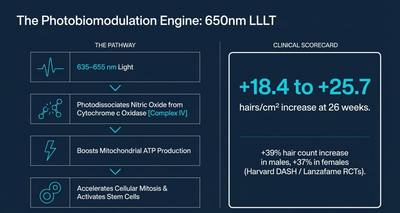
Low-level laser therapy at 635-655 nm produced a +18.4 to +25.7 hairs/cm2 increase at 26 weeks in the pooled readouts, with hair-count increases of +39% in males and +37% in females in the Harvard DASH and Lanzafame randomized trials. Dutasteride mesotherapy at 0.05% measured +75.5 hairs/cm2 at 24 weeks - the largest density figure in the deck - while carrying minimal systemic DHT reduction and avoiding the exposure profile of oral 5-ARIs.
Note what those figures actually measure. Density is a count per square centimetre of scalp; it is not shaft caliber, and it is not the same as cosmetically visible coverage. When a clinic quotes a single "hairs gained" number, ask whether it came from a 24-week or 26-week readout, because that window is the only one the pooled trials use.
| Endpoint | Agent | Measured change | Timepoint |
|---|---|---|---|
| Hair density | LLLT, 635-655 nm | +18.4 to +25.7 hairs/cm2 | 26 weeks |
| Hair count | LLLT, 635-655 nm | +39% in males / +37% in females | Harvard DASH / Lanzafame RCTs |
| Hair density | Dutasteride mesotherapy 0.05% | +75.5 hairs/cm2 | 24 weeks |
| Hair density | Activated PRP | Increase in total hair count | 3 / 6 / 9 / 12-month intervals |
| Hair fiber thickness | Activated PRP | Not significantly changed | 3 / 6 / 9 / 12-month intervals |
The PRP Paradox: Density Without Caliber
Activated platelet-rich plasma is the most misrepresented rung on the ladder. A meta-analysis of 43 RCTs covering 1,877 participants found that PRP activated with thrombin or calcium chloride successfully stimulates resting follicles and lifts total hair count, yet does not significantly increase the physical caliber or thickness of individual hair shafts. Density and shaft thickness are separate endpoints, and the pooled data separates them cleanly.
The honest trade-off: a patient chasing coverage gains can justify PRP; a patient promised thicker individual strands cannot. It is also injectable, carries injection-site reactions, and depends entirely on the activation protocol used. Side-by-side comparison guides of injectable and topical routes show the same split, and it is the split most marketing skips.
| Outcome | Direction in pooled data | What it means for a treatment plan |
|---|---|---|
| Overall hair density and recurrence reduction | Increases | Resting follicles are stimulated and total hair count rises |
| Individual hair fiber thickness | Not significantly changed | Physical caliber gain should not be promised |
| Activation method | Thrombin / calcium chloride | Protocol choice is part of the clinical decision, not an afterthought |
| Delivery | Injection | Carries injection-site reactions as the main local trade-off |
Why Monotherapy Ranks Below Combination
The 2026 intersection matrix gives the answer in one line. Five-percent topical minoxidil covers growth stimulation by prolonging the anagen phase. Low-dose 5-ARIs cover systemic defense by halting the DHT miniaturization cascade. Low-level laser therapy (mitochondrial ATP boost) or activated PRP (autologous growth factors) covers metabolic and regenerative support. Three non-competing pathways, and the 2026 gold-standard protocol simply wires them together - delivering more density and shaft thickness than any single treatment in the pooled evidence.
The pipeline reinforces the direction. Dutasteride mesotherapy at 0.05%, the biologic ABS-201 (a Phase 1/2a anti-prolactin-receptor monoclonal antibody) and Cosmerna (SAMiRNA-AR68 RNA interference that reduces androgen receptor mRNA and blocks the TGF-beta 1 paracrine signalling loop) each attack miniaturization from an angle the oral drugs never touched. The slide-by-slide science walks through those mechanisms in order.
| Presentation | Most defensible first step | Why, from the efficacy matrix |
|---|---|---|
| Male AGA, early-to-mid stage | Oral finasteride 1 mg | Systemic DHT suppression with a High density ceiling |
| No prior treatment of any kind | Topical minoxidil 5% | Universal baseline therapy; works a different pathway and stacks |
| Non-responder to chemical therapy | LLLT 650 nm | No systemic side-effect signal; +25.7 hairs/cm2 |
| Diffuse thinner chasing density | Activated PRP | Density gain without a caliber promise |
| Advanced loss, avoiding oral meds | Dutasteride mesotherapy 0.05% | +75.5 hairs/cm2 with minimal systemic DHT reduction |
What This Means in Scottsdale
For anyone in Scottsdale, Arizona weighing options, the ranking changes one practical habit: stop asking which single product works and start asking which pathway is still unaddressed. Early intervention is the only reliable defense, because once a follicle has fully miniaturized it cannot be revived through medical therapy alone. That is the whole case for assessing early rather than waiting for visible thinning to progress.
The sequencing logic also explains why a "weak" agent is not the same as a useless one. PRP sits at only a Moderate density ceiling on its own, yet it supplies a growth-factor pathway that minoxidil and finasteride do not touch, which is exactly why the matrix scores mechanisms rather than brands. Rank a treatment by the lever it pulls, and the ordering stops being arbitrary.
This article is educational information, not medical advice, and a qualified provider should assess the individual case. The hair-loss treatment tools let you sanity-check where a proposed regimen sits on the hierarchy before a consultation, so the conversation starts from mechanism rather than marketing.
Frequently Asked Questions
Is any single non-surgical treatment enough on its own?
By the 2026 ranking, no single agent is the best answer. The strongest standalone figures are LLLT at +25.7 hairs/cm2 and dutasteride mesotherapy 0.05% at +75.5 hairs/cm2 at 24 weeks, but the gold-standard protocol combines topical vasodilation, metabolic acceleration and systemic defense, and that combination outperforms every monotherapy on density and shaft thickness.
Why does PRP raise density but not hair thickness?
Because the two endpoints are different. Across 43 RCTs and 1,877 participants, activated PRP stimulated resting follicles and increased total hair count, but did not significantly increase the physical caliber of individual hair shafts. Ask which endpoint a quoted percentage describes.
How long before results are measurable?
The pooled readouts use a 24-week window for dutasteride mesotherapy at 0.05% (+75.5 hairs/cm2) and 26 weeks for LLLT (+18.4 to +25.7 hairs/cm2), with PRP tracked at 3, 6, 9 and 12 months. Anything shorter than a 24-week readout is not comparing like with like.
Get matched with hair restoration professionals →
Ready for a Professional Review?
We can connect you with qualified hair restoration professionals who can map your situation to the right treatment.
Get Matched with Hair Restoration Professionals