2026 Monotherapy Efficacy Rankings for Hair Regrowth

2026 Monotherapy Efficacy Rankings for Hair Regrowth

The 2026 clinical efficacy rankings list four standalone monotherapies, and each one carries a specific dose or wavelength rather than a vague promise. Low-level laser therapy operates at 635-655 nm through photobiomodulation and ATP generation. The 5-alpha reductase inhibitors work through systemic DHT suppression - oral finasteride at 1 mg and dutasteride at 0.5 mg. Topical minoxidil, supplied as 5% and 2% solutions, works through vasodilation and anagen prolongation. Activated platelet-rich plasma delivers autologous growth factors. Ranked by density ceiling, the order runs from dutasteride mesotherapy at +75.5 hairs/cm2 down to PRP, which moves density but not shaft thickness.

2026 clinical efficacy rankings of standalone hair regrowth monotherapies
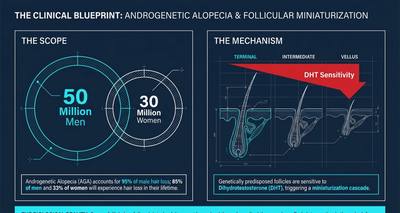
Slide from the regrowth-monotherapies deck: the four standalone monotherapy classes, their mechanisms and their named doses and wavelengths.

The Four Standalone Classes and What Each One Actually Does

Every rung on the ranking is defined by its mechanism, because mechanism explains both the ceiling and the side-effect profile. Photobiomodulation is a light-and-energy mechanism; 5-ARI therapy is a hormonal one; minoxidil is a vascular and cycle-timing one; PRP is a growth-factor delivery one. Put those four levers side by side and it becomes obvious why no two of them produce the same result.

The dosing detail is not administrative trivia. The ranking specifically names finasteride at 1 mg and dutasteride at 0.5 mg as the oral 5-ARI reference points, and minoxidil at 5% and 2% as the topical reference points. When a comparison does not state the concentration or wavelength, it is not comparing the same agent described in the 2026 matrix - a point covered in the slide-by-slide science breakdown.

Table 1 - The four standalone monotherapy classes in the 2026 rankings
ClassMechanismNamed dose / wavelengthDelivery
Low-level laser therapyPhotobiomodulation / ATP generation635-655 nmLight exposure (clinic or device)
5-alpha reductase inhibitorsSystemic DHT suppressionFinasteride 1 mg; dutasteride 0.5 mgOral
Topical minoxidilVasodilation / anagen prolongation5% and 2% solutionsTopical
Activated platelet-rich plasmaAutologous growth factorsActivated with thrombin / calcium chlorideInjected

Ranking by Density Ceiling

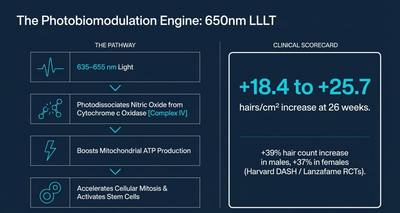
The matrix assigns an efficacy ceiling to each class: Very High for dutasteride mesotherapy at 0.05%, High for oral finasteride and for LLLT at 650 nm, Moderate-High for topical minoxidil 5%, and Moderate (density only) for activated PRP. Those labels map onto measured numbers: LLLT produced a +18.4 to +25.7 hairs/cm2 increase at 26 weeks with +39% hair count in males and +37% in females in the Harvard DASH and Lanzafame trials, while dutasteride mesotherapy at 0.05% produced +75.5 hairs/cm2 at 24 weeks.

Read those two windows carefully, because they are the whole basis of the ranking. One endpoint is measured at 24 weeks, the other at 26; both count hairs per square centimetre rather than cosmetic coverage. A ranking built on those readouts is a ranking of measurable density, and it should never be quoted as if it were a ranking of final appearance.

Table 2 - Efficacy ceilings and the numbers behind them
ClassEfficacy ceiling (density)Measured figureTimepoint / source
Dutasteride mesotherapy 0.05%Very High+75.5 hairs/cm224 weeks
LLLT (650 nm)High+18.4 to +25.7 hairs/cm226 weeks
LLLT (650 nm)High+39% males / +37% females hair countHarvard DASH / Lanzafame RCTs
Oral finasteride 1 mgHighCeiling rating; male AGA early-to-mid stage2026 treatment matrix
Topical minoxidil 5%Moderate-HighCeiling rating; universal baseline therapy2026 treatment matrix
Activated PRPModerate (density only)Density gain; caliber not significantly changed43 RCTs, 1,877 participants

Dosing, Delivery and the Trade-off Each Class Carries

Delivery decides the risk profile. Oral finasteride carries a hormonal systemic side-effect signal; topical minoxidil is associated with scalp irritation; LLLT shows no systemic side-effect signal in the matrix; activated PRP carries injection-site reactions; dutasteride mesotherapy at 0.05% achieves its density gains with minimal systemic DHT reduction, which is precisely how it avoids the oral 5-ARI exposure profile.

That is the trade-off to price before choosing a rung. A patient unwilling to accept any systemic exposure will rank the ladder differently from a patient who wants the highest measurable density and accepts the monitoring that comes with it. The ranking is objective; the choice is not.

Table 3 - Side-effect signal by delivery route
ClassSystemic side-effect riskPrimary local trade-off
Oral finasteride 1 mgHormonal (systemic)Requires provider oversight of the oral route
Topical minoxidil 5%Scalp irritationLocalised scalp reactions
LLLT (650 nm)None in the matrixAdherence to a repeated light protocol
Activated PRPInjection siteInjected; depends on the activation protocol
Dutasteride mesotherapy 0.05%Minimal systemicLocalised 5-ARI delivered to the scalp

Where Monotherapy Stops and Combination Begins

Every class in this ranking is a single pathway, and the 2026 intersection matrix states plainly that monotherapy is obsolete as a strategy. Five-percent topical minoxidil prolongs the anagen phase for growth stimulation; low-dose 5-ARIs halt the DHT miniaturization cascade for systemic defense; LLLT supplies a mitochondrial ATP boost or activated PRP supplies autologous growth factors for metabolic and regenerative support. The gold-standard protocol combines topical vasodilation with metabolic acceleration and systemic defense, and it delivers more density and shaft thickness than any single treatment.

The 2026 pipeline shows where the ladder is headed next: dutasteride mesotherapy at 0.05%, the biologic ABS-201 in Phase 1/2a trials (a monoclonal antibody targeting the prolactin receptor pathway), and Cosmerna (SAMiRNA-AR68), an RNA interference approach that reduces androgen receptor mRNA and blocks the TGF-beta 1 paracrine loop. If you want to stack a current regimen against a solid baseline, the side-by-side comparisons and the cost guide are the practical places to start.

Table 4 - Best-fit candidate by class (2026 treatment matrix)
ClassIdeal candidateWhy this class fits
Oral finasteride 1 mgMale AGA, early-to-mid stageSystemic DHT suppression at a High ceiling
Topical minoxidil 5%Universal baseline therapyAnagen prolongation that stacks with other pathways
LLLT (650 nm)Non-responders to chemicals; adjunct therapyHigh ceiling with no systemic side-effect signal
Activated PRPDiffuse thinners seeking densityGrowth-factor delivery aimed at resting follicles
Dutasteride mesotherapy 0.05%Advanced loss avoiding oral medicationVery High ceiling with minimal systemic exposure

Choosing a Rung in Scottsdale

For Scottsdale patients, the ranking is most useful as a checklist rather than a verdict: confirm the agent, the dose or wavelength, the density ceiling and the side-effect signal before comparing two plans. A regimen that names finasteride 1 mg is a different proposition from one that names an unspecified 5-ARI, and LLLT at 635-655 nm is a defined band, not a category of gadget.

This article is educational information, not medical advice, and a qualified provider should assess the individual case. In Arizona, where year-round sun exposure is a routine part of life, the practical question is less which monotherapy tops the table and more which combination a provider can sustain and monitor over the 24-week and 26-week windows the data uses. Read the ranking as a starting position, not a finish line.

Frequently Asked Questions

What tops the 2026 monotherapy ranking for density?

Dutasteride mesotherapy at 0.05%, at a Very High ceiling with +75.5 hairs/cm2 at 24 weeks and minimal systemic DHT reduction. Oral finasteride 1 mg and LLLT at 650 nm sit at a High ceiling, with LLLT measured at +25.7 hairs/cm2.

Why is PRP ranked last among the four classes?

Because its ceiling is Moderate and density-only. In a meta-analysis of 43 RCTs covering 1,877 participants, activated PRP stimulated resting follicles and raised total hair count but did not significantly increase the physical caliber of individual hair shafts.

Does the ranking mean I should use only one treatment?

No. The 2026 matrix calls monotherapy obsolete and specifies a gold-standard protocol that combines topical vasodilation, metabolic acceleration (LLLT or PRP) and systemic defense, producing more density and shaft thickness than any single treatment.

Get matched with hair restoration professionals →

Ready for a Professional Review?

We can connect you with qualified hair restoration professionals who can map your situation to the right treatment.

Get Matched with Hair Restoration Professionals

Related Articles

Compare your options: Browse all comparison guides →

Want help finding the right hair restoration provider? Tell us what you're looking for and we'll help you connect with Scottsdale providers who can help. Get matched with local providers → — no obligation.

Ready to Get Started?