LLLT at 650nm: The Photobiomodulation Evidence
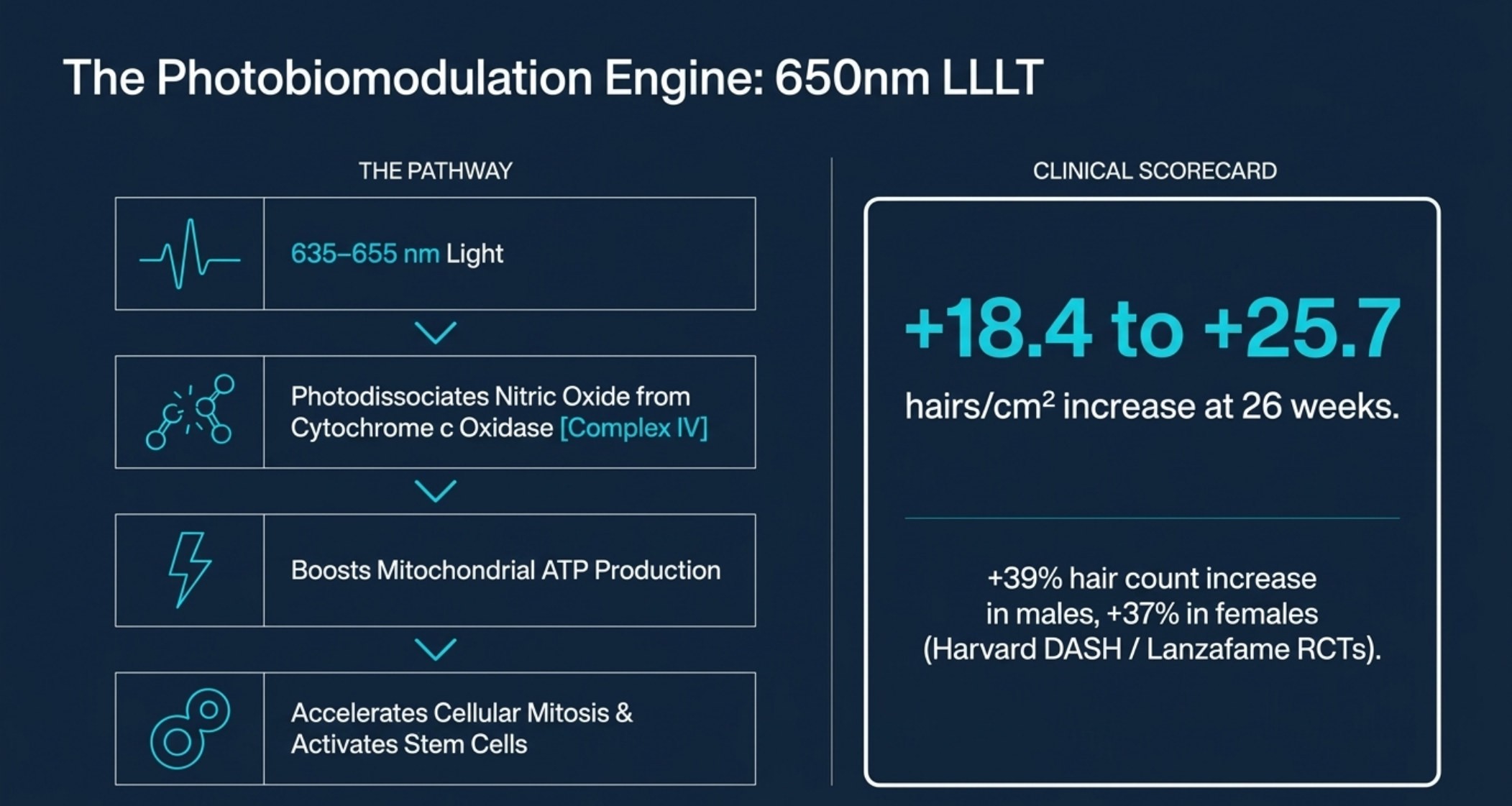
Low-level laser therapy is the only monotherapy in the 2026 ranking that works by supplying metabolic energy rather than by suppressing a hormone or dilating a vessel. The pathway runs from 635-655 nm light through photodissociation of nitric oxide from cytochrome c oxidase [Complex IV] to a measurable boost in mitochondrial ATP production. The clinical scorecard is equally specific: a +18.4 to +25.7 hairs/cm2 increase at 26 weeks, with +39% hair count in males and +37% in females in the Harvard DASH and Lanzafame randomized trials. The matrix rates its density ceiling as High and lists no systemic side-effect signal.
The Pathway: 635-655 nm Light and Cytochrome c Oxidase
Photobiomodulation is a four-step mechanism, not a vague sense of "stimulation". Light in the 635-655 nm band reaches follicular tissue; it photodissociates nitric oxide from cytochrome c oxidase, also known as Complex IV of the mitochondrial respiratory chain; removing that inhibitory nitric oxide lets the enzyme work normally, which boosts mitochondrial ATP production; and the resulting energy accelerates cellular mitosis and activates stem cells. Each step is a physical event with a target, which is why wavelength is the specification that matters most.
That last point separates a defined therapy from a category of gadget. The ranking names LLLT at 635-655 nm in the standalone monotherapy list and at 650 nm in the treatment matrix and photobiomodulation slide - a narrow band, not a marketing range. A device marketed as "laser therapy" without a wavelength is not describing the therapy this evidence covers.
| Step | What happens | Specification |
|---|---|---|
| 1. Exposure | Light reaches follicular tissue | 635-655 nm band |
| 2. Photodissociation | Nitric oxide is released from cytochrome c oxidase [Complex IV] | Molecular target named in the deck |
| 3. ATP boost | Mitochondrial ATP production rises | Energy supply to the follicle |
| 4. Cell response | Cellular mitosis accelerates; stem cells activate | Downstream effect on the follicle |
The Clinical Scorecard
LLLT's numbers are among the cleanest in the deck. Density rose by +18.4 to +25.7 hairs/cm2 at 26 weeks, and hair count rose +39% in males and +37% in females in the Harvard DASH and Lanzafame randomized controlled trials. In the efficacy matrix the same agent is recorded as a High density ceiling with the figure +25.7 hairs/cm2 attached.
The trade-off is adherence rather than tolerance. Because LLLT shows no systemic side-effect signal, it is often positioned for patients who are non-responders to chemical therapy or who are using it as an adjunct. The cost of that safety margin is that the protocol has to be repeated consistently across a 26-week window to reproduce the trial conditions - something a one-off purchase does not guarantee. The 26-week window is the benchmark to hold a protocol against.
| Endpoint | Measured result | Timepoint / source |
|---|---|---|
| Hair density | +18.4 to +25.7 hairs/cm2 | 26 weeks |
| Hair count, males | +39% | Harvard DASH / Lanzafame RCTs |
| Hair count, females | +37% | Harvard DASH / Lanzafame RCTs |
| Efficacy ceiling (density) | High | 2026 treatment matrix |
| Referenced density figure | +25.7 hairs/cm2 | 2026 treatment matrix |
| Systemic side-effect risk | None | 2026 treatment matrix |
Where LLLT Sits Relative to the Other Monotherapies
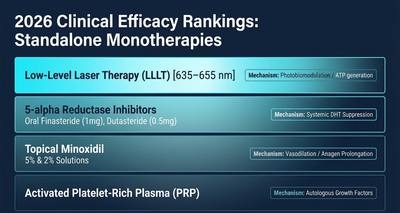
Ranked against the rest of the 2026 ladder, LLLT holds a High ceiling alongside oral finasteride 1 mg, below dutasteride mesotherapy at 0.05% (+75.5 hairs/cm2 at 24 weeks) and above topical minoxidil 5% at Moderate-High. Unlike finasteride, it carries no hormonal side-effect signal; unlike activated PRP, it is not injected and does not depend on a thrombin or calcium chloride activation step; unlike minoxidil at 5% and 2%, it is not associated with scalp irritation.
That profile explains its ideal-candidate designation: non-responders to chemical therapy, and patients using it as an adjunct. It is a High-ceiling option that does not force a systemic exposure decision - which is precisely the gap it fills in the matrix.
| Class | Density ceiling | Systemic side-effect signal |
|---|---|---|
| LLLT (650 nm) | High (+25.7 hairs/cm2) | None |
| Oral finasteride 1 mg | High | Hormonal (systemic) |
| Topical minoxidil 5% | Moderate-High | Scalp irritation |
| Activated PRP | Moderate (density only) | Injection site |
| Dutasteride mesotherapy 0.05% | Very High (+75.5 hairs/cm2) | Minimal systemic |
Combining Photobiomodulation with Other Pathways
LLLT's real strength appears when it is stacked. The 2026 intersection matrix assigns it to metabolic and regenerative support - the mitochondrial ATP boost - while 5% topical minoxidil handles growth stimulation by prolonging the anagen phase and low-dose 5-ARIs handle systemic defense by halting the DHT miniaturization cascade. The gold-standard protocol combining topical vasodilation with metabolic acceleration and systemic defense delivers more density and shaft thickness than any single treatment.
The logic is additive rather than redundant: minoxidil increases delivery of blood, oxygen and nutrients to the follicle, and LLLT raises the follicle's capacity to convert that supply into energy at Complex IV. Two levers on the same engine, which is why the matrix treats them as separate columns rather than competing options. The clinical hair-regrowth science guide covers the same non-competing pathway logic across the deck.
| Pathway column | Representative agent | What it contributes |
|---|---|---|
| Growth stimulation | 5% topical minoxidil | Prolongs the anagen phase |
| Systemic defense | Low-dose 5-ARIs | Halts the DHT miniaturization cascade |
| Metabolic / regenerative | LLLT (mitochondrial ATP boost) | Raises the follicle energy available for growth |
| Metabolic / regenerative (alternative) | Activated PRP | Delivers autologous growth factors |
Practical Trade-offs for Scottsdale Patients
For Scottsdale patients, the useful questions are concrete: is the device specified in the 635-655 nm band, is there a defined 26-week review, and is LLLT being used as a standalone or as the adjunct the matrix describes? A therapy with no systemic side-effect signal is easy to start and equally easy to abandon, and abandonment is the failure mode that the trial window exposes.
In Arizona, where outdoor activity is a year-round habit, a light-based protocol also has to fit a routine rather than compete with it, which makes adherence the deciding variable in most LLLT plans. This article is educational information, not medical advice, and a qualified provider should assess the individual case. If you want to weigh it against other routes first, the scalp cooling guide covers a different light-and-temperature mechanism in detail.
Frequently Asked Questions
What exactly does 635-655 nm light do to a follicle?
It photodissociates nitric oxide from cytochrome c oxidase [Complex IV], which boosts mitochondrial ATP production, then accelerates cellular mitosis and activates stem cells. The measurable result is a +18.4 to +25.7 hairs/cm2 increase at 26 weeks.
Does LLLT have side effects?
The 2026 matrix lists no systemic side-effect signal for LLLT at 650 nm, unlike oral finasteride 1 mg (hormonal), topical minoxidil 5% (scalp irritation) and activated PRP (injection site). The practical constraint is consistent use across the 26-week trial window, not tolerance.
Is LLLT better than minoxidil or finasteride?
It is different. LLLT sits at a High density ceiling (+25.7 hairs/cm2) and is designated for non-responders to chemical therapy or as an adjunct; oral finasteride 1 mg is also High but works by systemic DHT suppression. The matrix treats them as complementary pathways, not substitutes.
Get matched with hair restoration professionals →
Ready for a Professional Review?
We can connect you with qualified hair restoration professionals who can map your situation to the right treatment.
Get Matched with Hair Restoration Professionals