Androgenetic Alopecia: The Miniaturization Cascade Explained
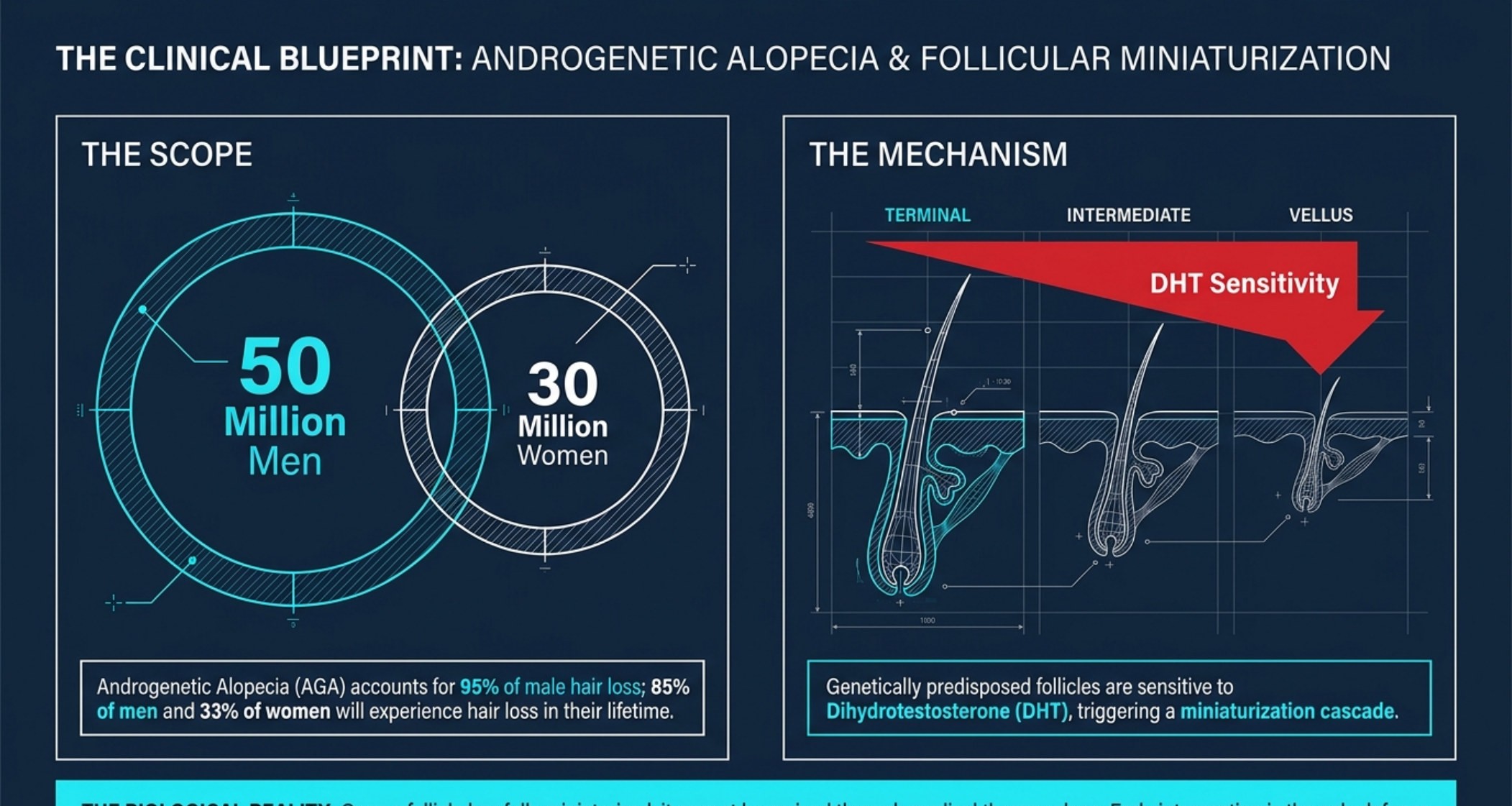
Androgenetic alopecia (AGA) is not diffuse shedding and it is not a stress reaction; it is a genetically programmed narrowing of individual follicles, and the numbers describing it are large. AGA accounts for 95% of male hair loss, roughly 50 million men and 30 million women carry it, and 85% of men and 33% of women will experience hair loss in their lifetime. The mechanism is a follicle-by-follicle sensitivity to dihydrotestosterone (DHT). The clinically decisive fact is the one patients hear last: once a follicle has fully miniaturized, it cannot be revived through medical therapy alone, which makes early intervention the only real defense.
The Scope: 50 Million Men, 30 Million Women
The scale is the reason AGA dominates every ranking of hair-loss treatments. AGA is behind 95% of male hair loss, and the lifetime figures - 85% of men, 33% of women - mean the condition is closer to a normal biological trajectory than an outlier event. When the parent category is that broad, a therapy that helps even a fraction of it moves millions of follicles.
The female figure matters just as much clinically. 30 million women living with AGA and a 33% lifetime risk means roughly one woman in three will notice thinning, yet the pattern differs from male loss, and the same ranking cannot simply be copy-pasted across both groups. That distinction changes which lever a provider reaches for first.
| Measure | Figure | What it tells you |
|---|---|---|
| Share of male hair loss caused by AGA | 95% | AGA is the dominant category, not one of several equal causes |
| Men living with AGA | 50 million | A therapy that helps a fraction moves a very large population |
| Women living with AGA | 30 million | Female presentation is a major cohort, not an edge case |
| Lifetime hair-loss risk, men | 85% | Thinning is closer to a normal trajectory than an outlier event |
| Lifetime hair-loss risk, women | 33% | Roughly one woman in three will notice thinning |
The Mechanism: DHT Sensitivity in Predisposed Follicles
The cascade starts with genetics, not behaviour. Genetically predisposed follicles are sensitive to dihydrotestosterone (DHT), and that sensitivity triggers a miniaturization cascade: each successive hair cycle produces a thinner, shorter shaft until the follicle stops producing a visible hair at all. Nothing in that chain is caused by shampoo, styling, or a single stressful month - which is why topical cosmetic fixes rarely hold.
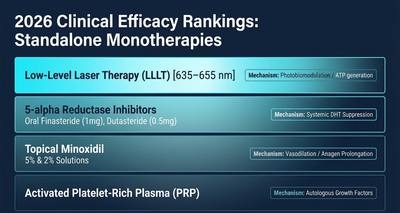
The practical consequence is that the target is the DHT signal reaching a sensitized follicle, not the scalp surface. That is exactly why the 2026 monotherapy rankings place systemic DHT suppression (oral finasteride 1 mg, dutasteride 0.5 mg) and localized 5-ARI delivery (dutasteride mesotherapy 0.05%) on different rungs of the same ladder, and why topical minoxidil - which works by vasodilation and anagen prolongation, not by blocking DHT - remains a baseline therapy rather than a DHT solution.
| Mechanism target | What it addresses | Representative agents (2026 deck) |
|---|---|---|
| Systemic DHT suppression | The driver of the miniaturization cascade | Oral finasteride 1 mg; dutasteride 0.5 mg |
| Localized 5-ARI delivery | DHT signalling confined to the scalp | Dutasteride mesotherapy 0.05% |
| Vasodilation / anagen prolongation | Time each follicle spends in growth | Topical minoxidil, 5% and 2% solutions |
| Photobiomodulation / ATP | Follicular metabolic energy | LLLT at 635-655 nm |
| Growth factor delivery | Resting-follicle stimulation | Activated PRP (thrombin / calcium chloride) |
Three Follicle States: Terminal, Intermediate, Vellus
Miniaturization is a continuum, and the deck names three states along it: terminal, intermediate and vellus. A terminal follicle produces a full, pigmented shaft. An intermediate follicle produces a narrower, shorter one. A vellus follicle produces the fine, near-colourless hair most visible at the hairline and crown. Tracking which state a zone is in tells you more about prognosis than any single density number.
This is where "DHT sensitivity" stops being an abstraction. Two patients can show identical shedding counts and sit at opposite ends of the cascade, one with intermediate follicles that still respond and one with zones already at vellus. The same treatment, applied to those two scalps, produces two different outcomes - not because the drug failed, but because the follicles were not at the same stage.
| Follicle state | Hair shaft produced | DHT sensitivity context |
|---|---|---|
| Terminal | Full, pigmented, thick shaft | Genetically predisposed follicles begin here |
| Intermediate | Narrower, shorter shaft | The cascade is under way; still structurally recoverable |
| Vellus | Fine, near-colourless hair | Fully miniaturized; not revivable by medical therapy alone |
The Point of No Return, and Why Timing Decides Everything
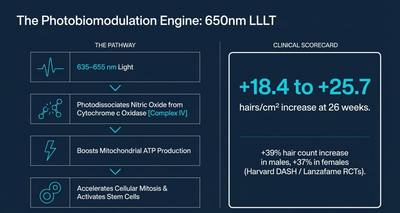
The biological reality in the 2026 guidelines is stated without hedging: once a follicle has fully miniaturized, it cannot be revived through medical therapy alone. Every medical intervention in the non-surgical ladder - minoxidil, 5-ARIs, LLLT at 635-655 nm, activated PRP - acts on follicles that still have structure left to work with. Density gains reflect that: LLLT measured +18.4 to +25.7 hairs/cm2 at 26 weeks with +39% in males and +37% in females, and dutasteride mesotherapy at 0.05% measured +75.5 hairs/cm2 at 24 weeks. Strong results, but results on follicles that were still recoverable.
The trade-off is therefore about time, not just money. Waiting converts a reversible intermediate zone into an irreversible vellus one, at which point the only remaining route is surgical rather than medical. That is the single most important thing to understand about AGA: it is a progressive condition with a narrowing window, and early intervention is described in the guidelines as the only defense.
| Stage of the cascade | Reversible with medical therapy? | Realistic aim of a protocol |
|---|---|---|
| Terminal follicles, early thinning | Yes | Preserve density and slow progression |
| Intermediate follicles | Yes, partly | Recover structure before it is lost |
| Zones already at vellus | No | Manage expectations; surgical routes become the remaining option |
| Any stage, untreated over years | Window narrows continuously | Early intervention is the only defense |
What This Means in Scottsdale
For Scottsdale residents, the cascade framework replaces the usual question - "am I losing hair?" - with two better ones: which zones are still intermediate rather than vellus, and which DHT-blocking or anagen-prolonging lever is appropriate for that stage. Arizona patients considering medical therapy should have those zones mapped before committing to a protocol, because the correct plan for an early-stage scalp looks nothing like the plan for an advanced one.
This article is educational information, not medical advice, and a qualified provider should assess the individual case. The hair-loss treatment tools can help you frame the stage question before a consultation, and how the matching process works explains what a proper assessment actually measures.
Frequently Asked Questions
Does androgenetic alopecia affect women as well as men?
Yes. AGA accounts for 95% of male hair loss, and roughly 50 million men and 30 million women live with it, with an 85% lifetime risk in men and 33% in women. Because the pattern and hormonal context differ, the treatment ladder is not applied identically to both groups.
Can a fully miniaturized follicle be brought back with medication?
No. Once a follicle has fully miniaturized, it cannot be revived through medical therapy alone. Medical monotherapies act on follicles that retain structure, which is why the guidelines treat early intervention as the only defense and why the realistic aim is preserving intermediate follicles, not resurrecting vellus ones.
Which stage should trigger a first assessment?
As soon as thinning is visible, because the terminal-to-intermediate-to-vellus progression is continuous. The pooled trial windows are 24 and 26 weeks, so a protocol started and reviewed against those readouts gives a clear signal while follicles are still in the recoverable band.
Get matched with hair restoration professionals →
Ready for a Professional Review?
We can connect you with qualified hair restoration professionals who can map your situation to the right treatment.
Get Matched with Hair Restoration Professionals